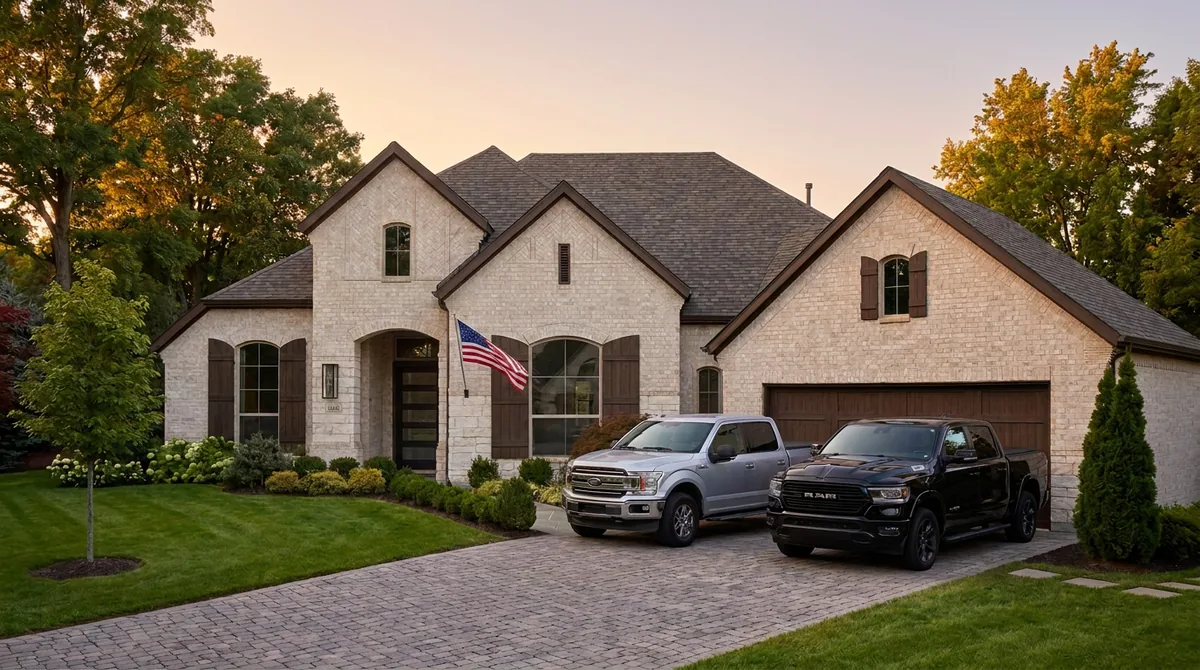
Looking for home insurance in Arlington, TX usually starts with a number: a renewal that jumped, or a lender asking for proof of coverage before closing. But the number only makes sense next to the house. A 1980s brick ranch near a creek and a newer two-story in south Arlington face very different questions about roofs, water and rebuild cost.
This is our hometown guide from our team in south Arlington: local housing, the creeks the City tracks, the storms behind claims, what premiums run, and how to get a quote. For statewide basics, see our full Texas homeowners guide.
By clicking Get My Free Quote, I give Robinson Legacy Partners LLC, an Allstate agency, and its licensed agents my prior express written consent, by electronic signature, to contact me with calls and text messages — including marketing calls and texts made using automated technology or an artificial or prerecorded voice — and by email, at the number and email I provided, about my insurance quote and related insurance products and services, even if my number is on a Do Not Call list. My information is never sold or shared with other agencies for their own marketing. Consent is not a condition of purchase; I can call (817) 262-5300 instead. Message frequency varies. Message and data rates may apply. Reply STOP to opt out, HELP for help. I agree to the Privacy Policy and Terms of Use, including the arbitration clause and E-SIGN consent.
What kind of homes are Arlington homeowners insuring?
The short answer: Homes worth around $305,000 at the median, and a housing stock where about half the units date from 1970 to 1989, so rebuild cost, roof terms and older plumbing come first.
| Measure | Arlington | Why it matters |
|---|---|---|
| Owner-occupied housing rate | 54.3% | Owners need a homeowners policy; renters and landlords need different ones. |
| Median value, owner-occupied homes | $304,700 | Market value, not rebuild cost. |
| Median monthly owner costs with a mortgage | $2,019 | If insurance is escrowed, a premium change shows up here. |
| Housing units built 1970–1989 | About 51% | Roof, plumbing and wiring age matter. |
The City’s assessment listed the age of the housing stock as a weakness. Plenty of those houses are fully updated, but when we review Arlington renewals, we ask first: how old is the roof, and when were the water heater, supply lines and electrical panel replaced?
How much does home insurance cost in Arlington, Texas?
The short answer: TDI reports the average Texas homeowners premium was $3,291 in 2024 and $3,506 for 2025 (preliminary), and since we couldn’t verify an Arlington-only figure, treat that as context, not a quote.
Other figures differ. The NAIC, summarized by the Insurance Information Institute, put Texas at $2,397 for 2022, third highest in the country, counting HO-3 style policies only. Quote websites publish city figures from a sample house. Different years, samples and policy types produce different averages; none is your price.
Your Arlington premium depends on rebuild cost, roof age and settlement terms, deductibles, the home’s age and updates, claims history and protective devices. Insuring your home and cars together may lower what you pay; our Arlington car insurance guide covers the auto side. For the statewide picture, see what homeowners insurance costs in Texas.
Which Arlington creeks and floodplains matter for your home insurance?
The short answer: Rush, Johnson, Village, Fish and Cottonwood creeks and their tributaries are the ones the City studies and maps, and flooding from any of them is excluded from a standard homeowners policy.
The City of Arlington counts 140 miles of streams, creeks and drainage channels in the city, and it studies its watersheds to update floodplain maps and plan flood control. Here’s what City sources say:
| Creek or watershed | What the City has reported |
|---|---|
| Rush Creek | The City’s largest watershed; it flooded during Tropical Storm Hermine in 2010. |
| Sublett Creek (Rush Creek tributary) | A 2016 federal grant funded buying and demolishing six floodplain homes. |
| Johnson Creek | Studied from near W. Arbrook Blvd to the city limit at SH 360. |
| Fish and Cottonwood creeks | Studies completed by 2015, with flood projects underway. |
| Upper Village Creek, Lynn Creek, Bowman Branch | Studies under way in 2019 to update FEMA’s flood maps. |
The City’s voluntary flood buyout program reports buying and demolishing 93 high-flood-risk properties since 2009, and its 2025 repetitive loss plan still lists 35 unmitigated repetitive loss areas, places with repeated paid flood claims.
None of that water is a homeowners claim. Standard policies don’t cover flood, meaning water rising from outside (FloodSmart). Flood coverage is a separate policy, usually through the National Flood Insurance Program (NFIP), and it generally starts 30 days after purchase. See our flood insurance page.
What does Arlington’s Class 5 flood rating mean for your premium?
The short answer: Arlington is Class 5 in FEMA’s Community Rating System, and the City says that gives NFIP flood policies in Arlington a 25 percent discount.
The Community Rating System (CRS) rewards cities for floodplain management beyond the minimum, on a scale from 10 (no discount) to 1. According to the City’s CRS page, Arlington has been in the NFIP since 1974 and the CRS since 1991. It reached Class 5 in 2020, up from Class 6, and the City announced that the larger discount, described there as up to 25 percent, took effect October 1, 2021, for property owners and renters with NFIP policies.
The rating lowers the price of a flood policy; it doesn’t add flood coverage to a homeowners policy. And the 30-day NFIP wait still applies, so don’t wait for a flood watch.
By clicking Get My Free Quote, I give Robinson Legacy Partners LLC, an Allstate agency, and its licensed agents my prior express written consent, by electronic signature, to contact me with calls and text messages — including marketing calls and texts made using automated technology or an artificial or prerecorded voice — and by email, at the number and email I provided, about my insurance quote and related insurance products and services, even if my number is on a Do Not Call list. My information is never sold or shared with other agencies for their own marketing. Consent is not a condition of purchase; I can call (817) 262-5300 instead. Message frequency varies. Message and data rates may apply. Reply STOP to opt out, HELP for help. I agree to the Privacy Policy and Terms of Use, including the arbitration clause and E-SIGN consent.
Which storms should Arlington homeowners plan for?
The short answer: Spring hail, straight-line wind and tornadoes, flash flooding along creeks, and hard winter freezes each hit a different part of your policy, and flooding isn’t covered by homeowners insurance at all.
The Insurance Information Institute, citing NOAA’s Storm Prediction Center, reports Texas had 902 major hail events (one inch or larger) in 2025, the most of any state. Tarrant County has a long hail history: in the Mayfest storm of May 5, 1995, softball-size hail fell in Fort Worth, and the National Weather Service in Fort Worth estimates about $2 billion in damage across Tarrant and Dallas counties.
On April 3, 2012, an EF-2 tornado with estimated 135 mph winds tracked 4.6 miles from Kennedale into Arlington, crossing Highway 287 and I-20 between Kelly Elliott Road and Green Oaks Blvd and ending near Lake Arlington, according to the National Weather Service.
Roof, siding, windows
A wind and hail claim, subject to that deductible and your roof terms.
Trees, fences, structure
Fences and detached garages fall under other structures coverage.
Rising water
Excluded. Needs a separate flood policy bought ahead.
Burst pipes
Often covered, possibly with limits. Slow leaks aren’t.
Two terms decide what a hail claim pays: your wind and hail deductible, often a percentage of the dwelling limit (see how Texas wind and hail deductibles work), and whether your roof is settled at replacement cost or actual cash value (see insuring a Texas home with an older roof).
- 1% wind and hail deductible: you pay $3,200; the policy pays about $12,800.
- 2% deductible: you pay $6,400; the policy pays about $9,600.
How do clay soil and hard freezes affect an Arlington home policy?
The short answer: Slow foundation movement from shifting clay usually isn’t covered because earth movement is a common exclusion, while sudden burst-pipe damage in a freeze often is.
Slow leaks aren’t.
North Texas clay shrinks in drought and swells after rain, and many Arlington houses sit on slabs. TDI’s home insurance guide lists earth movement among common exclusions and foundation or slab damage among common add-on coverages.
After the February 2021 winter storm, TDI reported 510,772 claims and about $11.2 billion in expected insured Texas losses as of March 31, 2022, about 85% on residential property policies (TDI winter weather summary). TDI says burst-pipe damage is often covered, with possible limitations; long-running leaks usually aren’t.
What changed for Arlington homeowners in 2026?
The short answer: TDI’s preliminary 2025 average rose to $3,506, and two 2025 Texas laws apply to residential policies issued or renewed after January 1, 2026.
- Higher average. $3,506 (2025, preliminary) vs. $3,291 in 2024 (TDI).
- Credit refresh (SB 1644). Insurers that use credit must update it at least every three years (TDI Bulletin B-0012-25).
- Appraisal (SB 458). Residential policy forms must include an appraisal provision for disputes over the amount of a loss (same bulletin).
- Local flood planning. City Council approved an updated repetitive loss plan on September 16, 2025.
It’s a good year to read your renewal closely.
How do you get a home insurance quote in Arlington?
The short answer: Gather your declarations page and house details, check your flood zone, pick a deductible you can afford, then call or send your ZIP to a local licensed agent.
Robinson Legacy Partners is the office of Clarence Robinson II, an Allstate agent in Arlington, at 700 Highlander Blvd, Suite 405, near I-20. Our team helps in English, Spanish, Arabic, Hindi, Punjabi, Urdu and Coptic.
- Pull your current declarations page
It shows your dwelling limit, deductibles in dollars and endorsements.
- Write down the house basics
Year built, square footage, roof age and material, foundation type, and system updates.
- Check your flood zone
Look up the address on FEMA’s map and ask about NFIP coverage if you’re near a creek.
- Pick a deductible you could pay tomorrow
Turn the wind and hail percentage into dollars you could cover from savings.
- Ask about bundling and discounts
Home and auto together, or monitored alarms, may lower what you pay. Eligibility varies.
- Talk it through with a local agent
Call (817) 262-5300 or send your ZIP for a coverage review.
Already insured? Our policy review guide lists what we check. See also our home insurance page.
The bottom line
Home insurance in Arlington comes down to local facts: much of the housing dates from the 1970s and 1980s, creeks run all over the city and flood is a separate policy, and hail, wind and freezes drive the claims. With Texas premiums this high, your coverage needs to work when a storm hits.
Send us your ZIP below or call (817) 262-5300. We’ll put your deductibles in dollars, check your dwelling limit and roof terms, look up your flood zone, and quote coverage that fits your house. We’re open Monday through Friday, 8:30 to 5.
By clicking Get My Free Quote, I give Robinson Legacy Partners LLC, an Allstate agency, and its licensed agents my prior express written consent, by electronic signature, to contact me with calls and text messages — including marketing calls and texts made using automated technology or an artificial or prerecorded voice — and by email, at the number and email I provided, about my insurance quote and related insurance products and services, even if my number is on a Do Not Call list. My information is never sold or shared with other agencies for their own marketing. Consent is not a condition of purchase; I can call (817) 262-5300 instead. Message frequency varies. Message and data rates may apply. Reply STOP to opt out, HELP for help. I agree to the Privacy Policy and Terms of Use, including the arbitration clause and E-SIGN consent.
Arlington home insurance FAQ
Does Arlington’s Class 5 flood rating lower NFIP premiums for homes outside the floodplain?
Yes, according to the City of Arlington. Arlington is a Class 5 community in FEMA’s Community Rating System, and the City says all property owners and tenants receive a 25 percent discount on National Flood Insurance Program policies; it doesn’t limit that to high-risk zones. The discount lowers the price of a separate flood policy; it doesn’t add flood coverage to a homeowners policy. NFIP coverage generally takes effect 30 days after purchase, so decide before storm season.
Should my dwelling limit match my Tarrant Appraisal District market value?
Not necessarily. The Tarrant Appraisal District defines market value as the price a property would sell for on the open market, and that value includes your land. Your dwelling limit should reflect what it would cost to rebuild the house at current labor and material prices, which can be higher or lower. Copying the appraisal can leave you underinsured or insuring land that can’t burn. Ask how your policy’s rebuild estimate was calculated, and update it after remodels.
How do I check whether my Arlington home is in a FEMA flood zone?
Enter your full address in FEMA’s Flood Map Service Center at msc.fema.gov. The City of Arlington’s flood hazard zones page also links to the City’s own map viewer. A lower-risk zone isn’t a no-risk zone: FEMA reports nearly one-third of NFIP claims from 2014 to 2024 came from outside high-risk areas. The City updates maps after watershed studies on creeks such as Rush, Johnson and Village, so check again if you’re buying or haven’t looked in years.
Where is Robinson Legacy Partners’ office for Arlington home insurance quotes?
Our office is at 700 Highlander Blvd, Suite 405, Arlington, TX 76015, in south Arlington near I-20. It’s the agency of Clarence Robinson II. We’re open Monday through Friday, 8:30 a.m. to 5 p.m., at (817) 262-5300. You don’t need to come in; most people start by phone or by sending their ZIP online. Our team helps in English, Spanish, Arabic, Hindi, Punjabi, Urdu and Coptic, and serves Arlington, Dallas-Fort Worth and the rest of Texas.
Does an Arlington home built in the 1970s or 1980s need different coverage than a newer house?
It uses the same kind of homeowners policy, but some details need more attention. Check that the dwelling limit reflects rebuild cost. Roof age and material affect how a hail claim is settled, and TDI notes some companies switch older roofs to actual cash value. Older supply lines, water heaters and electrical panels raise water-damage and eligibility questions, and updates may help. Many homes from that era sit on slabs, so ask what any foundation endorsement covers.
Last reviewed by the Robinson Legacy Partners team on .